
Lessons from Incident Research, Secure Openings, and Environmental Design
Partner Alliance for Safer Schools
White Paper: What Your Doors Are Telling You About Your Security Preparedness
The volunteers who make up the Partner Alliance for Safer Schools (PASS) bring together their research and expertise from the education, public safety, and industry communities to develop and support a coordinated approach to effectively apply proven security practices in schools. The PASS team is also dedicated to developing white papers on specific, school-safety topics.
The content in these white papers may point to specific products, brands, or organizations as illustrations of how certain safety and security measures are implemented. PASS does not endorse specific products or brands. Together, the volunteers and partners of the PASS share a single vision: making all schools safer is both achievable and urgently needed.
AUTHORS
Joe Eleuterio – Incident Research, Laura Frye Weaver – Doors, Hardware & Codes, Ben Crum – CPTED & Environmental Design, Kevin Wren – School Security Operations
KEY TOPIC
Recognizing and evaluating school doors and openings as critical components of a comprehensive security system, and as indicators of a school’s broader security preparedness.
PROBLEM SOLVED
School openings are often evaluated as individual hardware components rather than as part of a larger security system. This can cause schools to overlook issues involving policies, training, maintenance, access control, glazing, emergency procedures, and human behavior that can affect whether an opening performs as intended.
This white paper provides PASS-aligned guidance to help school leaders and security, facilities, and emergency preparedness professionals evaluate the performance of complete openings as comprehensive life-safety systems rather than individual hardware components.
RELEVANT PASS GUIDELINES SECTIONS
- II. Introduction: Structure of the PASS Guidelines; Baseline Practices and Obligations; Risk Assessment — A Prerequisite; Layers of Protection; Safety and Security Components; Using the PASS Guidelines to Formulate a Comprehensive Security Plan
- III. District-Wide Layer: Policies and Procedures, Training, Communication, and Inspection and Maintenance
- VI. Building Perimeter Layer: Access Control and physical security of building openings
- VII. Classroom/Interior Layer: Classroom openings, access control, lockdown considerations, and related security practices
MOST RELEVANT FOR
- K-12 school administrators
- School and district security leaders
- Facilities, operations, and maintenance leaders
- Architects and security consultants
- School safety and emergency preparedness professionals
- Law enforcement and first responders
- Fire and life safety officials
TIME TO READ
Approximately 18 minutes
Executive Summary
Every security plan eventually reaches a door.
During an emergency, the performance of a school’s openings can influence movement, protection, emergency response, and ultimately, survival. Yet doors rarely fail because of a single defective component. They reflect the quality of leadership, planning, maintenance, policies, training, and investment that shaped them long before the emergency began.
Recent incident research suggests that properly secured openings can influence the outcome of violent events. At the same time, environmental design, maintenance, policies, training, and human behavior all influence whether those openings perform as intended.
This paper explores how school leaders can evaluate their building’s openings as indicators of overall security preparedness and provides practical recommendations that support the layered approach promoted by the Partner Alliance for Safer Schools (PASS).
I. Introduction
Every Security Plan Eventually Reaches a Door
Every day, students, teachers, staff, and visitors pass through countless doors without giving them a second thought.
During an emergency, however, those same doors become something much more significant.
Doors become critical components of a school’s security, life safety, and emergency response systems. Their ability to close, latch, lock, provide free egress, support authorized access, and perform as intended may influence how occupants protect themselves, how emergency responders move through the building, and ultimately, the outcome of an incident.
Yet doors should not be viewed simply as pieces of hardware.
Every opening reflects a series of decisions involving leadership, planning, design, policies, training, maintenance, inspection, communication, and ongoing investment. When a door performs as intended, it is often because an organization has proactively invested in preparedness, long before an emergency occurs. When it does not, the problem frequently extends well beyond the hardware itself.
This paper provides a framework to help school leaders, architects, security professionals, facility managers, code officials, and emergency responders evaluate school openings through a broader lens. Rather than focusing on individual products or hardware solutions, it examines how school openings contribute to overall security preparedness and what their condition and performance can reveal about a school’s broader safety and security practices.
The discussion builds upon the layered approach to school security promoted by the Partner Alliance for Safer Schools (PASS) and reflects principles found throughout the PASS Guidelines, the ASIS School Security Standard, recommendations from the National Association of State Fire Marshals (NASFM), and other nationally recognized guidance. While these organizations approach school security from different perspectives, they share a common objective: creating learning environments that support security, life safety, and the educational mission of the school.
Recent research conducted by the Advanced Law Enforcement Rapid Response Training (ALERRT) Center at Texas State University, examined all 54 FBI-defined K–12 active shooter events focusing on the security of openings. The findings reinforce the importance of secured doors while also demonstrating that the performance of the entire opening matters. Where successful breaches of locked openings occurred, glazing—not mechanical defeat of the locking hardware—was the identified vulnerability. These findings are explored in greater detail in Section II.
We recognize that every school and campus has unique needs. PASS does not recommend specific products or prescribe a single solution for every school. Instead, it seeks to identify common principles that support effective school security, examine how openings contribute to those principles, and encourage schools to evaluate whether their openings are prepared to perform when they are needed most.
Ultimately, every security plan reaches a door.
The question is not whether that moment will come.
The question is whether the opening—and the organization behind it—will be prepared.
II. What the Research Revealed
Recent research from the Advanced Law Enforcement Rapid Response Training (ALERRT) Center at Texas State University provides important insight into how doors actually performed during school-based active shooter events.
The study examined 54 school-based active shooter events from 2000 through 2025 and identified 66 individual doors with documented interactions with perpetrators. Researchers reviewed law enforcement records, after-action reports, direct contact with schools and agencies, and media reporting to examine whether door locks and access-control measures reduced harm during these incidents.
Secured vs. Unsecured Doors
One of the clearest findings was the difference between secured and unsecured openings.
Secured doors were associated with a 16.7% chance of casualties compared with 50% for unsecured doors.
The research also found that perpetrators successfully entered through 29 of the 66 doors studied. Of those successful entries, 16 were unlocked and four were propped open, meaning approximately 69% of successful entries occurred through doors that were already unsecured.
These findings reinforce a straightforward point: whether an opening is actually secured when it is needed matters.
Real-World Examples: Prevention and Delay
The research also documented incidents in which secured exterior doors affected the attacker’s ability to enter a building.
At Margolin Hebrew Academy, a locked exterior door denied the attacker entry. At Mount Horeb Middle School, a secured exterior door prevented the attacker from gaining access to the building. At Dennis Intermediate School, the attacker ultimately entered by shooting through glass, but the secured opening created delay that provided additional time for law enforcement response.
These incidents demonstrate that opening performance is not necessarily an all-or-nothing proposition. A secured opening may prevent entry, redirect an attacker, or create valuable time.
Prevention is the goal, but delay matters.
Sandy Hook: An Earlier Lesson
The 2012 attack at Sandy Hook Elementary School provides additional context for the importance of securing classroom spaces.
Classroom locking arrangements at the time created challenges because some doors could not be secured from inside the room without a key. Following the tragedy, the Sandy Hook Advisory Commission emphasized the importance of classroom doors that teachers or substitutes could lock from inside.
The lesson was significant: occupants should not have to enter the corridor—or move toward a threat—to secure the space they are already in.
Sandy Hook also illustrates the importance of considering the complete opening, including glazing, rather than evaluating the locking hardware in isolation.
A Need for Better Information
The research also identified an important limitation: post-incident reports do not consistently document how doors and openings performed.
Details such as lock function, door construction, glazing configuration, whether the opening was secured, and how a breach occurred may be incomplete or absent from investigative and after-action reports.
More consistent documentation of door interactions following violent incidents would strengthen future research and provide a clearer understanding of what actually occurred.
Better data leads to better recommendations—and ultimately, better outcomes.
What the Research Tells Us
Taken together, the research demonstrates that secured openings can prevent entry or create meaningful delay, while vulnerabilities elsewhere in the opening can affect performance even when the locking hardware functions as intended.
These findings provide an evidence-based foundation for the sections that follow, which examine how the complete opening—and the organization responsible for it—contributes to school security preparedness.
The research gives us the evidence. The question for schools is what their own openings reveal when viewed through that evidence.
III. Every Door Tells a Story
“When you walk through a school, what story are the doors telling?”
Most people walk through a door without giving it a second thought. They see a way to enter or leave a room. School safety professionals may notice the lock, the closer, the access control system, or whether the opening is fire-rated. Experienced door, hardware, and facility professionals often see something much more significant.
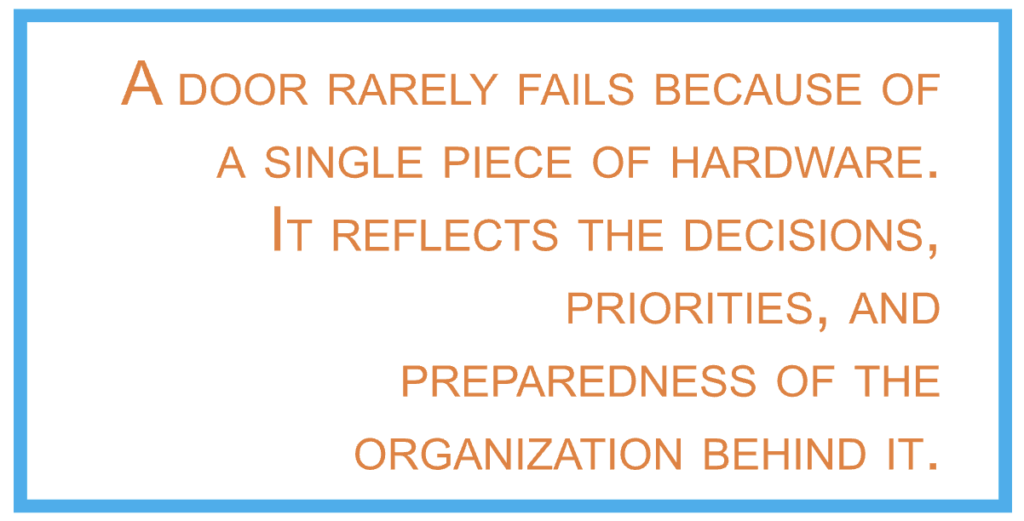
The condition, operation, and design of a school’s doors reveal how an organization approaches safety, maintenance, training, and preparedness. A door rarely fails because of a single defective component. More often, its condition reflects hundreds of decisions made by architects, school administrators, contractors, installers, maintenance personnel, inspectors, and end users, often years before anyone reaches the opening.
A properly functioning door is the visible result of effective leadership, thoughtful planning, routine maintenance, quality construction, appropriate funding, and a culture that values life safety.
Conversely, a door that fails to close, latch, lock, or operate as intended often reflects broader organizational challenges rather than isolated hardware deficiencies.
For this reason, doors should be viewed not simply as building components, but as indicators of an organization’s approach to security preparedness.
Every security plan eventually reaches a door. The question is whether that door is prepared to do its job.
Leadership
Preparedness begins with leadership.
School leaders establish priorities, allocate resources, and create the culture that determines whether security remains a continuous process or becomes a reaction to the latest incident.
Organizations that consistently invest in inspections, maintenance, training, and long-term planning often have openings that perform reliably because leadership has established clear expectations and accountability.
The question is rarely whether leadership values safety. Rather, it is whether that commitment is consistently reflected in everyday decisions.
Leadership establishes priorities through every budget, every policy decision, and every maintenance decision. Eventually, each of those decisions reaches a door.
Policies and Procedures
Even the best hardware cannot compensate for unclear or inconsistent procedures.
Policies establish how exterior doors are managed, when classrooms remain locked, how visitors are screened, who responds to reported deficiencies, and how emergency procedures are implemented.
When policies fail to align with the installed hardware, confusion often follows. Likewise, when procedures require staff to work around the intended function of the opening, the result is frequently reduced security, reduced code compliance, or both.
Training
People perform best when expectations are clear and practiced. Effective training helps ensure that staff understand how openings are intended to function during both routine operations and emergencies. Teachers should understand how classroom locks operate. Substitute teachers should not have to discover how to secure a classroom during an emergency; they should receive clear information and instruction on classroom security procedures before they are expected to implement them. Facility, custodial, and maintenance personnel should understand why doors must close, latch, lock, and operate as intended, recognize conditions that require repair, and understand how deficiencies may affect both security and life safety. Office staff should understand and consistently uphold visitor access procedures.
Training helps transform hardware into an effective life safety system. Hardware alone doesn’t become a system because of training; it becomes effective because training, policies, maintenance, and leadership all work collaboratively.
Inspection and Maintenance
Doors are among the most frequently used components within a school. Thousands of operating cycles, changing environmental conditions, modifications, and everyday wear gradually affect performance.
A door that fails to latch during an incident rarely becomes defective at the critical moment. The condition often develops over months or years without correction.
Consistent inspection, maintenance, and detailed documentation help identify and correct deficiencies before they affect routine operations or emergency response.
Funding and Resource Allocation
Preparedness requires investment.
Funding decisions influence replacement schedules, staffing, inspection frequency, access control upgrades, glazing improvements, and maintenance resources.
Limited budgets require prioritization, but deferred maintenance should be recognized as a growing operational risk rather than postponed work. Deferred maintenance rarely announces itself; it accumulates quietly until the day the door fails to perform. Each investment made today will minimize uncertainty during an emergency, and minimize damages from poor preparedness, tomorrow.
Communication
Ownership of secured school openings is a shared responsibility which cannot be delegated to one person. Architects, security consultants, facility personnel, teachers, administrators, law enforcement, fire officials, hardware suppliers, maintenance technicians, and inspectors all influence how an opening ultimately performs.
Preparedness improves when these disciplines communicate early, understand one another’s priorities, and recognize that every decision ultimately influences how that opening will perform when it is needed most.
Culture
Perhaps more than anything else, doors reveal organizational culture.
A culture of preparedness is reflected in:
- Prompt repair of deficiencies.
- Respect for fire and life safety features.
- Routine inspections.
- Staff awareness.
- Accountability.
- Continuous improvement.
Conversely, propped-open doors, disabled closers, unauthorized modifications, and neglected deficiencies often indicate that security has become a lower organizational priority.
You cannot purchase a culture of preparedness, nor can it be achieved through hardware alone. It is demonstrated every day through inspection, maintenance, training, accountability, and continuous improvement.
Different Openings, Different Purposes
Not every opening within a school is expected to perform the same function.
Exterior entrances, classroom doors, administrative offices, stairwell doors, fire barriers, smoke barriers, mechanical rooms, and other secured spaces support different operational, security, and life safety objectives. The hardware, access control, and operational procedures associated with these openings will vary based on their intended use and the risks they are designed to address.
For example:
- Exterior entrances help control access to the building while supporting secure visitor management and emergency egress.
- Classroom doors protect occupants, support instructional activities, and facilitate emergency lockdown procedures.
- Stairwell and egress doors provide safe evacuation routes while maintaining compartmentation and preventing unauthorized access where appropriate.
- Fire- and smoke-rated openings limit the spread of fire and smoke, protecting occupants and supporting emergency response.
- Administrative and support areas often require controlled access while maintaining efficient daily operations.
Although these openings serve different purposes, they should all perform reliably, support the school’s operational objectives, and function as intended when needed.
Bringing It Together
Every opening represents the combined work of planners, architects, contractors, hardware suppliers, installers, maintenance personnel, school administrators, teachers, inspectors, and emergency responders.
When a door performs as intended during an emergency, it is rarely because of one exceptional product. Rather, it is because an entire organization has invested in planning, training, inspection, maintenance, communication, and continuous improvement.
Likewise, when an opening fails to perform, the problem often extends well beyond the hardware itself. Perhaps the most important lesson is this: Doors do not create preparedness. They reveal it.
The condition of an opening reflects the organization responsible for it, its priorities, planning, maintenance practices, and commitment to protecting the people who use the building every day.
Recognizing that every opening tells a story naturally leads to the next question:
What should every secure opening be expected to do?
IV. What Should Every Secure Opening Do?
A secure opening is much more than a door equipped with locking hardware. It is a complete assembly designed to support security, life safety, accessibility, and the daily operation of the school.
When evaluating school openings, the focus should not begin with products or manufacturers. It should begin with performance.
Regardless of the type of hardware installed, every secure opening should consistently perform several essential functions.
Close
A secure opening should close completely when it needs to be secured. Doors that are intended to close on their own should do so reliably and without obstruction.
An opening that remains partially open cannot be expected to provide security, maintain fire or smoke compartmentation where required, or support access control. Whether during normal operations or an emergency, the ability of the door to return to the closed position is fundamental to its intended performance.
Latch
Once closed, the opening should positively latch.
Proper latching helps ensure the opening remains secure and resists unintended opening caused by pressure, vibration, or attempts to force entry. A door that does not latch consistently should not be considered secure, regardless of the locking hardware installed.
Lock
The opening should provide the level of security appropriate for its intended purpose while allowing occupants to quickly secure the space when necessary.
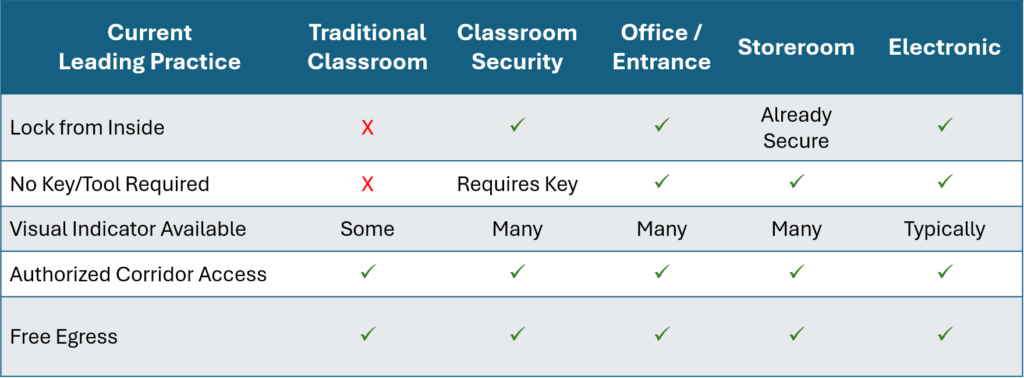
Current leading practices increasingly emphasize classroom openings that can be secured from inside the room while minimizing unnecessary actions during an emergency. Regardless of the specific lock function selected, the opening should support the school’s security objectives, operational procedures, and emergency plans.
Allow Free Egress
Security should never prevent occupants from leaving the room when necessary.
Every classroom opening should permit free and unobstructed egress in accordance with applicable life safety and accessibility requirements. During an emergency, occupants must be able to evacuate quickly without special knowledge, tools, or effort beyond that permitted by applicable codes.
Life safety and security are complementary objectives, not competing priorities.
Permit Authorized Access
While unauthorized entry should be restricted, authorized personnel, including school staff and emergency responders when appropriate, must be able to gain access efficiently.
The selected hardware should support established operational procedures while maintaining accountability for access and security.
Protect Glazing
The performance of an opening extends beyond the lock.
Recent incident research has demonstrated that glazing in doors, sidelites, and adjacent windows can present vulnerabilities that may allow unauthorized entry even when the locking hardware performs as intended. As a result, schools should evaluate the complete opening assembly, including glazing, when assessing security preparedness.
Security improvements should always be considered in conjunction with applicable fire protection, life safety, and building-code requirements.
Resist Defeat
A secure opening should be difficult to unintentionally defeat during normal school operations.
Be Inspected
A secure opening cannot be assumed to function properly simply because it was installed correctly.
Routine inspections help identify deficiencies such as damaged hardware, doors that fail to close or latch, unauthorized modifications, and other conditions that may reduce the effectiveness of the opening.
Inspection provides an opportunity to identify and correct problems before they affect daily operations or emergency response.
Be Maintained
Inspection identifies deficiencies. Maintenance restores performance.
Regular maintenance helps ensure that openings continue to operate as designed throughout their service life. Prompt repair of deficiencies, replacement of damaged components, and correction of unauthorized modifications all contribute to a more reliable and resilient security program.
Preparedness is demonstrated not only by how an opening performs during an emergency, but by the commitment to maintaining that performance every day.
An opening that closes, latches, locks, supports free egress, permits authorized access, addresses glazing vulnerabilities, and is routinely inspected and maintained provides a strong foundation for both everyday operations and emergency response.
These performance expectations are reflected in current guidance from organizations such as PASS, ASIS, NASFM, and recent ALERRT research.
V. Current Guidance
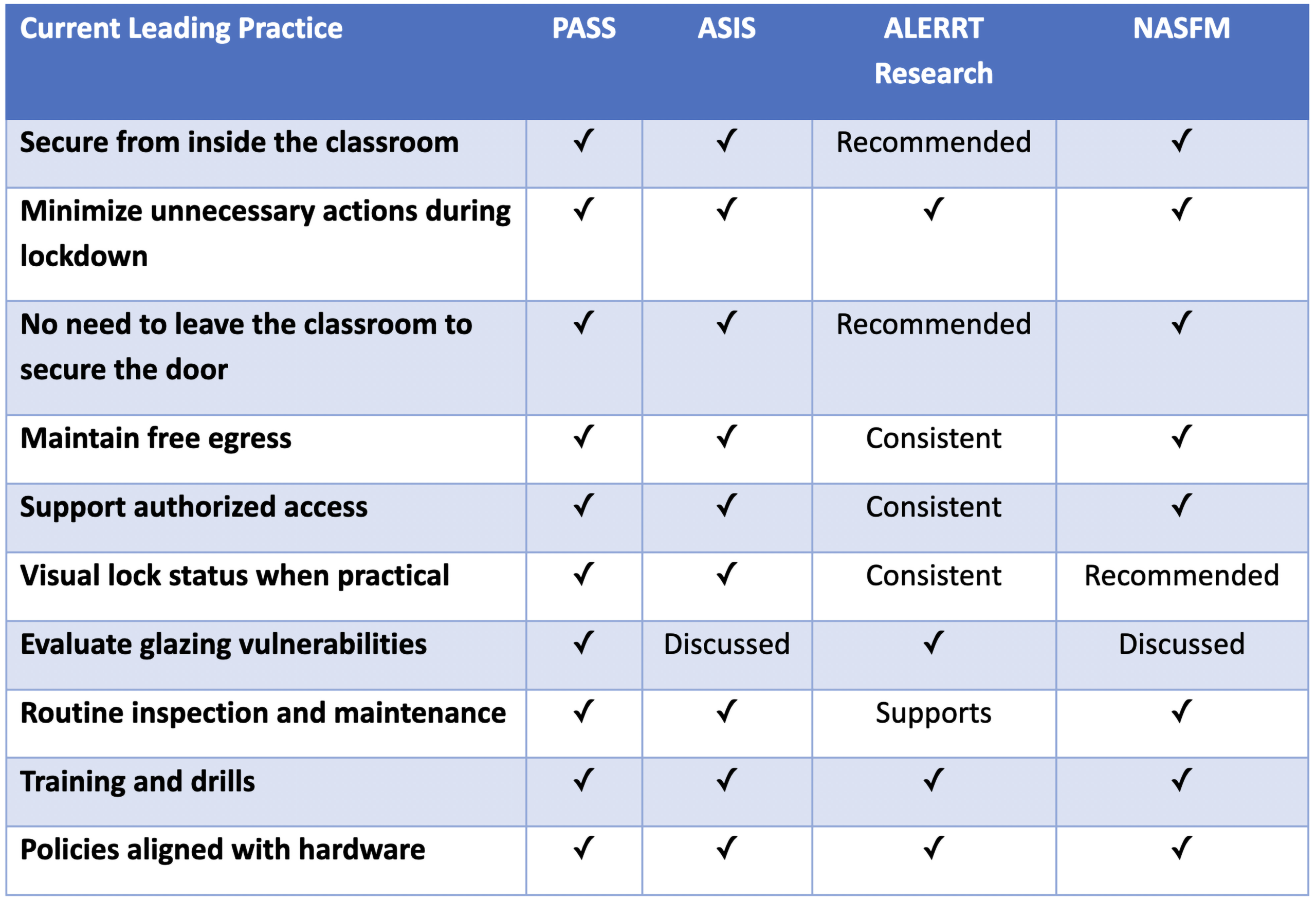
Recent guidance from organizations including the Partner Alliance for Safer Schools (PASS), ASIS International, the National Association of State Fire Marshals (NASFM), and research conducted by the Advanced Law Enforcement Rapid Response Training (ALERRT) Center demonstrates a growing consensus regarding the performance expected of classroom openings.
Each of these organizations contributes a unique perspective to school security. PASS provides guidance on layered protection and school security practices. ASIS emphasizes governance, risk assessment, and security management. ALERRT contributes research and lessons learned from active attack events. NASFM focuses on integrating security improvements with fire and life safety principles. Together, these perspectives reveal substantial agreement regarding the performance expected of classroom openings.
Although each organization approaches school security from a different perspective, their recommendations consistently emphasize that classroom doors should support rapid protective actions, maintain life safety, and function reliably during both routine operations and emergencies.
Rather than recommending specific manufacturers or products, current guidance focuses on operational performance and human factors.
The following table summarizes the common themes found across these national resources.
A Common Direction
While the language varies among organizations, the direction is remarkably consistent.
Today’s guidance places less emphasis on selecting a particular lock function and greater emphasis on ensuring that classroom openings support occupants during both routine school operations and emergency situations.
The recommendations increasingly recognize that hardware should:
- Support rapid decision-making
- Minimize unnecessary actions during emergencies
- Preserve life safety and accessibility
- Reduce opportunities for human error
- Integrate with the school’s broader security strategy
This evolution reflects lessons learned from incident research, advances in security technology, and continued collaboration among educators, architects, code officials, fire service professionals, law enforcement, and security practitioners.
These common recommendations provide the framework for evaluating classroom lock functions, discussed in the next chapter.
VI. Selecting Classroom Lock Functions
One of the most common questions school administrators, architects, and facility managers ask is: “Which locks should we use for our classrooms?”
While understandable, that question often starts the conversation in the wrong place.
A better question is: “What should we expect our classroom doors to do?”
The answer should not begin with a manufacturer’s catalog or a list of available lock functions. It should begin with the operational and security objectives of the school.
Over the past two decades, recommendations for classroom security have continued to evolve as schools, researchers, code officials, and security professionals have learned from real incidents. Today’s guidance increasingly emphasizes classroom doors that can be secured quickly from inside the room, while minimizing unnecessary actions during an emergency and maintaining free egress and authorized access.
Rather than asking which lock is “best,” schools should evaluate whether a lock function supports the way people actually use the building every day, and whether it will help occupants respond effectively when conditions suddenly change.
Operational Considerations
Classroom doors are expected to perform under a wide range of conditions.
They support instruction, supervision, cleaning, maintenance, visitor management, after-hours activities, emergency response, and, when necessary, lockdown procedures.
The selected lock function should support these activities without encouraging workarounds or creating unnecessary complexity.
Schools should consider questions such as:
- Can the classroom be secured quickly when needed?
- Can staff easily determine whether the door is locked?
- Does the hardware support authorized access without compromising security?
- Does the opening maintain free egress at all times?
- Will substitute teachers, support staff, and emergency responders understand how the opening operates?
A classroom door should support the school’s operations, not require staff to adapt their procedures to compensate for hardware limitations.
Human Behavior
Hardware should be designed with people in mind.
Research in emergency management and human factors consistently demonstrates that stress affects perception, memory, and decision-making. Tasks that seem simple during routine conditions may become significantly more difficult during a crisis.
Every additional action required to secure a classroom introduces another opportunity for hesitation, confusion, or error.
For this reason, current recommendations increasingly encourage reducing unnecessary steps whenever practical. Features such as the ability to secure the door from inside the classroom and visual confirmation of lock status can simplify decision-making and improve consistency during stressful situations.
The objective is not simply to make the hardware easier to operate. The objective is to support human performance when it matters most.
Daily Operation
An effective classroom lock function should support the school’s educational mission without compromising security.
Teachers, administrators, substitute teachers, custodial personnel, and students interact with classroom doors throughout the day. Routine activities such as restroom breaks, small group instruction, deliveries, and transitions require doors to function in a way that supports both instruction and security.
When daily operational needs are not adequately considered, staff may develop workarounds that unintentionally reduce the effectiveness of the school’s security plan. One common example is the use of magnets, wedges, tape, or other improvised methods to prevent doors from latching or to avoid repeatedly unlocking the door for students returning from the restroom or other routine activities. While these practices may seem convenient, they defeat the intended operation of the opening and can compromise both security and life safety.
Rather than relying on makeshift solutions, schools should ask why those workarounds have become necessary. Do the hardware, policies, and daily procedures support one another? Can teachers manage normal classroom activities without defeating the security features that have been intentionally designed into the opening?
Convenience is an important operational consideration, but it should never outweigh security or life safety. The most effective classroom door is one that supports the realities of daily operation while remaining ready to perform as intended during an emergency.
The way a classroom door is used every day is often the best predictor of how it will function during an emergency. If a door is routinely prevented from latching or locking during normal operations, it may not provide the level of protection expected when it is needed most.
Emergency Use
An emergency places very different demands on both people and hardware.
Occupants may have only seconds to recognize a threat, communicate with others, secure the classroom, and protect students.
During these situations, the opening should support a rapid, predictable, and intuitive response.
Current leading practices increasingly emphasize classroom doors that can be secured from inside the room without requiring occupants to enter the corridor or perform unnecessary actions. While individual hardware solutions may vary, the underlying objective remains the same: reduce complexity, minimize delay, and help occupants take appropriate protective actions as quickly as possible.
The hardware should support the emergency response—not become another obstacle to overcome.
Balancing Security, Life Safety, and Daily Operations
Every hardware decision involves tradeoffs.
Schools must balance security, life safety, accessibility, operational efficiency, maintenance, cost, and long-term sustainability. These factors should all be considered as part of the decision-making process.
However, not all tradeoffs provide the same level of support for today’s recommended security practices.
Operational convenience should not come at the expense of occupant protection. Likewise, security improvements should not compromise life safety, accessibility, or code compliance.
The goal is not to identify a single lock function that is appropriate for every school. The goal is to select hardware that best supports the school’s security objectives while remaining consistent with current recommendations, applicable codes, and everyday operational needs.
VII. Security Begins Before the Door
With physical security and doors, we always look at doors as the last line of defense. Ideally, security teams should implement early intervention long before a potential disaster reaches the door. Teams should evaluate how to push the threat beyond the perimeter as much as possible, to get it as far away from the building as possible.
This is where Special Education Parent Teacher Association (SEPTA) and the PASS security layers come in. SEPTA relates to these safety frameworks by advocating for inclusive, accessible, and all-hazards emergency planning that accounts for students with functional, access, or sensory needs, while PASS implements a secured perimeter approach, from a district level, all the way into the classroom. Both SEPTA and PASS assess natural access control, surveillance, and ensure that entry points to the school remain as openly visible as possible. All of these steps avoid sole dependence on the physical attributes of the door.
Teams should attempt to control what they can—to naturally observe and predict the intentions of a person on the approach, long before they reach the door.
Schools must strike a balance between maintaining a welcoming environment, and a sense of belonging for the students and staff who are meant to be there, while simultaneously remaining vigilant. SEPTA recognizes the importance of intended paths and controlled movement of visitors, such as approved vs. non-approved pathways on a school property. SEPTA also emphasizes the importance of sight lines in an entryway. Minimal trees and low vegetation are encouraged at an entrypoint so as to maintain clear sight lines for first responders and staff.
Wayfinding should be intuitive on a school campus, and signage should be installed when needed. In addressing navigation from a human standpoint, security teams should be asking:
- Is the layout confusing for a first-time visitor?
- Is a new visitor naturally going to know where to go?
- Does a visitor have to have special knowledge to get to something?
- Is the entrance and office easy to find?
- Can staff see the entrances from their offices?
- Do students have a quick and easy path to safety?
- Can responders orient themselves with ease?
A security measure that cannot be understood or used by the people expected to rely on it may not perform as intended during an emergency.
Guide People Where You Want Them to Go
Effective wayfinding supports both daily operations and emergency response.
Schools should consider whether:
- A first-time visitor can readily identify the appropriate entrance.
- Visitors are naturally directed toward a controlled point of entry.
- Staff can observe key entrances and approaches.
- Signage is clear and intuitive.
- Landscaping and other site features preserve appropriate sight lines.
- Parking and pedestrian routes support controlled visitor movement.
- Lighting supports visibility around entrances, walkways, and parking areas.
- Emergency responders can quickly orient themselves and identify critical building access points.
These questions are not separate from door security. They help determine which doors people approach, how those doors are used, and when the opening becomes part of the security response.
Every Layer Supports the Next
No single layer can eliminate every risk.
Policies, communication, training, site design, access control, doors and hardware, emergency response, maintenance, and human behavior work together. A weakness in one layer can place greater demands on the layers behind it.
The classroom door may ultimately become the final physical barrier between an occupant and a threat—but effective security begins long before anyone reaches that door.
VIII. Designing for Human Behavior
Security systems are ultimately used by people, often under stressful and rapidly changing conditions.
During an emergency, people may have less time to process information, remember unfamiliar procedures, or complete a complicated series of actions. For that reason, effective security planning should not depend on perfect decision-making under pressure.
The safest procedure is not necessarily the one that works best on paper. It is the one people can understand and perform when it matters.
Security measures should therefore be intuitive, familiar, and consistent with normal use whenever possible. Securing a classroom should not require occupants to remember an unfamiliar sequence, locate a special tool, or perform multiple unnecessary steps.
Training and practice also matter. Familiar actions are easier to recall and perform under stress than procedures encountered for the first time during an emergency.
This is particularly important for people who may be less familiar with the building or its security procedures. A substitute teacher, for example, should be able to determine quickly how to secure a classroom without having to discover the procedure during an emergency.
Visual information can also reduce uncertainty. Clear signage, understandable controls, and visual indicators that allow an occupant to confirm whether a door is locked can provide immediate feedback without requiring additional actions.
When evaluating an opening or security procedure, schools should consider:
- Can the intended user understand how it works?
- Can the space be secured quickly and without special knowledge or tools?
- Can occupants readily determine whether the door is secured?
- Is the action consistent with what staff have been trained and practiced to do?
- Could stress, confusion, or unfamiliarity make the procedure difficult to perform?
- Can a substitute teacher or other unfamiliar user operate it successfully?
IX. Security Is a System
One theme remains constant in our research: no single product, procedure, or technology can create a secure school. Security is not a collection of products. It is a system in which people, policies, the physical environment, technology, and properly functioning openings must work together. A weakness in one area can affect the performance of the others. The effectiveness of the system depends not simply on the strength of each individual layer, but on how well those layers support one another.
Every Decision Matters
Decisions intended to improve one aspect of an opening can affect others. A change made for security may affect egress or accessibility. A maintenance shortcut may affect locking or latching. An operational practice intended for convenience may unintentionally defeat a security measure. For this reason, decisions about school openings should be evaluated as part of the complete system—not in isolation. Security, life safety, accessibility, daily operations, and emergency response must continue to work together.
X. Questions Every School Should Ask
“If you’ve seen one school, you’ve seen one school.”
Every school is unique. Building age, campus layout, staffing, resources, and operational procedures all vary, and they all influence security decisions. Rather than prescribing a single solution, school leaders should periodically evaluate their facilities by asking thoughtful, practical questions about how their openings support both everyday operations and emergency preparedness.
The following questions are intended to spark discussion, identify opportunities for improvement, and support continuous evaluation.
▢ Classroom Openings
- Can every classroom be secured quickly from inside the room?
- Can teachers immediately determine whether the classroom door is locked?
- Can classroom doors be secured without exposing occupants to unnecessary risk?
- When classroom doors are closed, do they close completely and latch securely?
- Do classroom lock functions support both daily operation and emergency procedures?
▢ Daily Operations
- Are staff able to carry out normal classroom activities without defeating the intended operation of the door?
- Have teachers developed workarounds, such as propping doors open or using magnets or other devices to prevent doors from latching?
- Do policies, procedures, and hardware support one another, or are staff adapting to limitations in the opening?
- Are substitute teachers and support staff familiar with classroom security procedures?
▢ Inspection and Maintenance
- Are classroom and exterior doors routinely inspected?
- Are deficiencies documented and repaired promptly?
- Are unauthorized modifications identified and corrected?
- Are preventive maintenance activities scheduled before problems become failures?
▢ Physical Security
- Have glazing vulnerabilities been evaluated?
- Does the campus naturally direct visitors toward a controlled point of entry?
- Are access control measures appropriate for the school’s operations?
- Does the physical environment support natural surveillance and effective supervision?
▢ Emergency Preparedness
- Have local law enforcement and fire officials participated in planning or building walkthroughs?
- Have emergency procedures been practiced under realistic conditions?
- Do staff understand both the capabilities and limitations of the installed hardware?
- Does the hardware support a rapid, predictable response during an emergency?
▢ Continuous Improvement
- Are security decisions informed by current research, lessons learned, and leading practices?
- Has the school reassessed its security program following renovations, staffing changes, or significant incidents?
- Are security, life safety, accessibility, and educational operations considered together during decision-making?
- If an incident occurred tomorrow, would school leaders have confidence that their openings would perform as intended?
If your doors could tell the story of your school’s security preparedness today, what would they say?
XI. Recommendations
The following recommendations provide a practical framework for schools seeking to strengthen the performance of their openings and improve overall security preparedness.
Recommendation 1:
Conduct a Comprehensive Door Assessment
Evaluate exterior, classroom, and other critical openings to determine whether they support the school’s current security objectives.
Assess each opening for operational performance, code compliance, accessibility, and life safety. Verify that doors close, latch, lock, and function as required for their intended purpose, and identify conditions that could reduce their effectiveness during an emergency.
Recommendation 2:
Review Classroom Lock Functions
Review existing classroom lock functions to determine whether they support current operational needs and leading security practices.
Rather than focusing on specific products, evaluate whether classroom doors can be secured quickly, intuitively, and consistently while maintaining free egress and authorized access.
If the hardware requires staff to develop workarounds or conflicts with established procedures, additional evaluation may be warranted.
Recommendation 3:
Evaluate Glazing and Adjacent Openings
Assess glazing in doors, sidelites, and adjacent windows to determine whether it presents vulnerabilities that could allow unauthorized entry or compromise secured openings.
When improvements are necessary, evaluate available solutions that are appropriate for the facility, comply with applicable codes, and support the school’s overall security strategy.
Recommendation 4:
Strengthen Inspection and Maintenance Programs
Develop or enhance inspection and preventive maintenance programs that identify deficiencies before they become operational failures.
Promptly address damaged hardware, doors that fail to close or latch properly, unauthorized modifications, and other conditions that may reduce security or life safety.
Preparedness is demonstrated long before an emergency through consistent inspection, maintenance, and documentation.
Recommendation 5:
Improve Staff Training
Ensure teachers, administrators, substitute teachers, custodial personnel, support staff, and new hires understand how classroom openings are intended to operate during both routine activities and emergencies.
Training and onboarding should include proper operation of locking hardware, visitor access procedures, reporting maintenance concerns, and the importance of avoiding practices that defeat the intended function of security features.
Recommendation 6:
Review Crime Prevention Through Environmental Design (CPTED)
Evaluate how the physical environment influences access, visibility, supervision, and movement throughout the campus.
Consider opportunities to improve natural surveillance, access control, territorial reinforcement, and maintenance while integrating these strategies with the school’s overall security program.
Recommendation 7:
Coordinate with Emergency Responders
Work collaboratively with law enforcement, fire service, emergency management, and other stakeholders to ensure that emergency procedures align with the school’s security measures.
Joint planning, training, and exercises help identify operational challenges before an emergency occurs and improve coordination during an actual incident.
Recommendation 8:
Conduct Periodic Reassessments
Security preparedness is not a one-time project.
Schools evolve. Buildings change. Staff turnover occurs. Technology advances. New threats emerge.
Establish a process for periodically reassessing security measures, incorporating lessons learned from drills, exercises, incidents, and actual events, and updating policies, procedures, and physical security measures as needed.
Continuous improvement is one of the strongest indicators of a resilient security program.
Our most important takeaway is that you view every opening as part of a larger security system rather than as an isolated building component.
Every door reflects decisions related to leadership, planning, design, policies, training, maintenance, communication, and technology. Evaluating those openings through this broader lens enables schools to identify opportunities for improvement before deficiencies become failures.
Ultimately, the objective is not simply to install better hardware; it is to create openings that consistently support students, educators, visitors, and emergency responders while advancing the school’s mission to provide a safe, secure, and welcoming learning environment.
References
ASIS International. School Security Standard. 2025.
Advanced Law Enforcement Rapid Response Training (ALERRT) Center, Texas State University. Research and incident analysis related to secured openings and active attack incidents.
Sandy Hook Advisory Commission. Final Report of the Sandy Hook Advisory Commission. March 6, 2015.
Ready to get the Guidelines?
The most comprehensive information available on best practices specifically for securing school facilities, vetted extensively by experts across the education, public safety and industry sectors.